What does a democratic transition even look like?
Transition Lit, Part 1

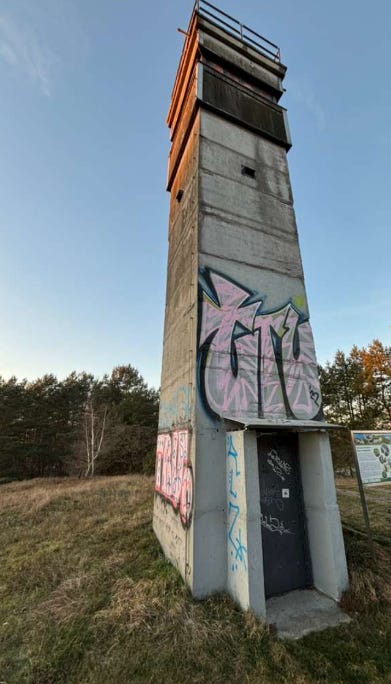
Everyone knows about the Berlin Wall, but to be honest I hadn’t really thought much about how small and specific of an example it was next to the long militarized border that once divided East and West Germany. The photo above is one that I took while visiting the former border between the two; the now abandoned watchtower was one of a series of measures set up by the GDR. Along the GDR side of the former border there is a partially paved mini-highway for East German military vehicles to traverse single file up and down the country, so that they can quickly respond to any crisis along the frontier between capitalist West and socialist East. I was shown around by a colleague’s father, who for a time had worked as a West German border guard. He pointed out the tall staves along the border painted in the colors of the German flag, which helps visitors understand where the respective guard posts stood during the Cold War. Under the GDR stave was a stone with handwriting explaining the date that someone had fled to freedom in the West many decades ago. The towers used to have guard dogs on leashes tethered to them, to help sniff out anyone trying to cross, and potentially maul them in the process of stopping their flight.
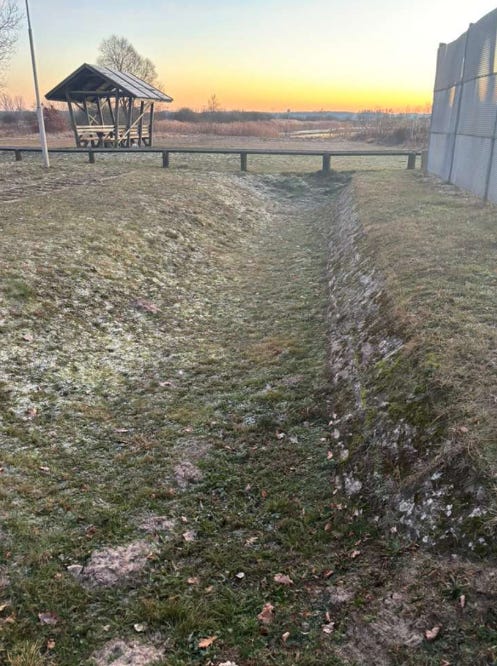
Further along the border we come across one section of the border fence and defensive works that were preserved entirely intact. The border had been two parallel fences enclosing a series of defensive works. Between this initial fence and the fence that faced the West German border was a small partially submerged bunker which East German guards could look out from and aim at escapees from the GDR; they had discretion as to whether to fire or not, even though that meant shooting fellow citizens in the back. Beyond the bunkers but before the chain-link fences, the earth slumps into a ditch, with the slope facing the East German side and the little earthen wall facing the West German side; the goal was to stop a vehicle being used to ram through the fence, but clearly the worry was that the fence would be rammed from the Easterners trying to escape, not rammed by Westerners trying to break in or overrun the boarder.
This impression was further consolidated by seeing the tight metal fence that was the last line of defense between the East and freedom in the West. I gasped when I saw that the screws that held the fence to the large posts that kept it up at regular intervals were facing the West not the East; again, the worry was not West Germans unscrewing them and climbing in, representing a military threat, but East Germans unscrewing them and climbing out, representing the flight of fellow citizens, mostly civilians. While no longer in place, the fence also had the added measure of shrapnel devices that could be triggered by movement, which would shred any would-be escapees into hamburger meat.
And yet, despite all of this, people still did flee. They fled even though they might be shot or arrested for long periods and tortured. They fled despite the dogs ready to maul them and the local informants who might help sniff them out. They fled despite the possibility that the motion of climbing the fence might trigger a device that could shred them into mince meat. They fled despite the risk to their loved ones, many of whom would have to be left behind for practical reasons and who would face possible reprisals for their family member’s apostacy and flight. Despite every barrier and threat, hundreds of thousands continued to leave the GDR even after the erection of the Berlin Wall and the militarization of the border with West Germany.
It doesn’t take a genius to figure out that part of my fascination with the GDR’s harsh, even cruelty, as it tried and failed to prevent its exodus lies in the fact that it reminds me of a much harsher version of Cuba. Somewhere between 20-25% of the island’s population has left in half a decade. That is, in a word, insane, especially for a country not in a state of war or suffering from an environmental catastrophe of some kind. With so much of the island’s infrastructure and economy on life support, the Trump administration’s embargo of Venezuela will further reduce already greatly reduced imports of all important fuel which Cuba’s energy infrastructure needs to keep the lights on even a few hours a day nationally. This is critical because the Cuban government has spent the past half decade doing everything possible to insulate the capital against the near 24 hour blackouts facing the rest of the country. Other factors, like wanting to keep the capital functioning for economic and administrative reasons, obviously also play a role here, but during the national blackouts of late 2024 and early 2025, the big threat that led to Diaz-Canel dressing himself once again in military uniform (as in 2021) was when Havana’s protests in late 2024 started to take over parts of Central Havana.
Maybe the country’s government will squeak through yet again, but also maybe not. The degree of uncertainty is fairly novel to the 2020s and is worth thinking about seriously. Being a historian, it is only natural that my approach to this problem is to see what the literature on regime collapse and democratic transitions says, as well as looking at some of the more prominent relevant examples to Cuba’s case.
Over the coming months, as an excuse to piggyback off of the fact that I have to review my old notes on various authors on regime durability for the dissertation, I will post short Substacks on key texts that I think will help shed light on Cuba’s current crisis.
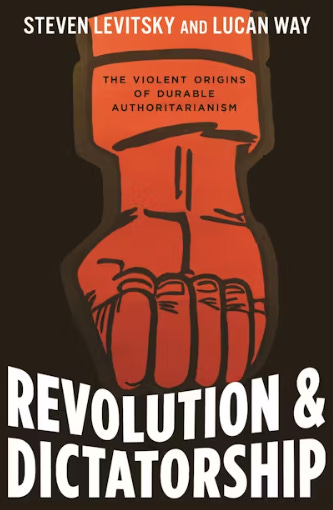
The next post, the first of the actual series, will focus on Levitsky & Way’s recent opus, Revolution & Dictatorship: The Violent Origins of Durable Authoritarianism.
Always a pleasure to read you, Andrés. Great to see you will write about regime durability, it may come handy this year
Look forward to this.