Cuba learning from Iran?
On the story about the Cuban importation of attack-drones

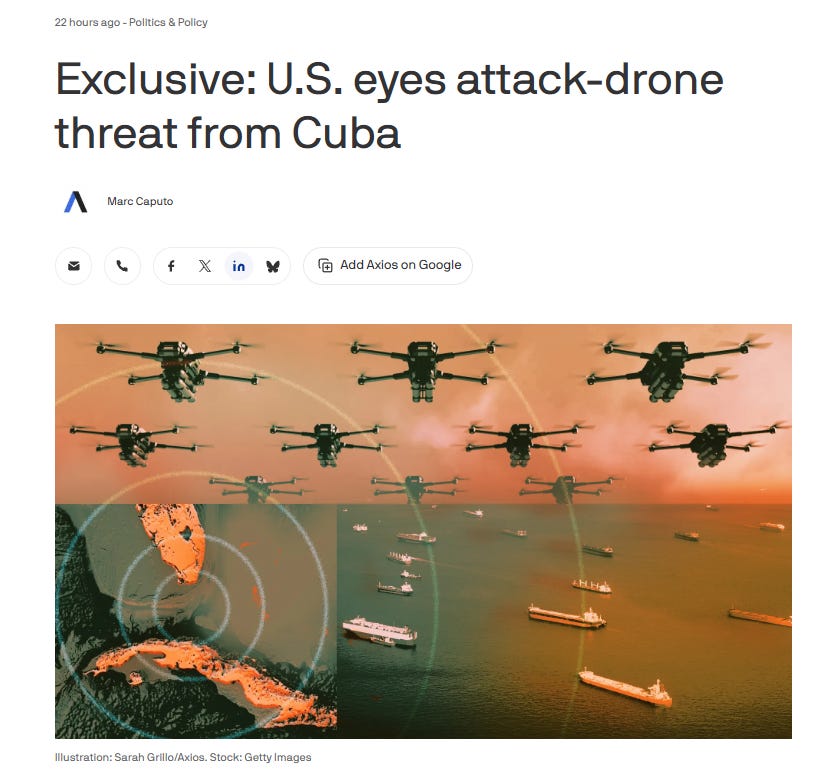
Yesterday Marc Caputo over at Axios dropped a piece about how Cuba was allegedly importing attack-drones. You can read the piece itself here.
In contrast to the reception to the piece, the piece itself is actually quite measured. It’s clear that its sourcing for the story is an unnamed US government official; in short, this is not something they are saying is an independently confirmed fact. They also have sources agreeing Cuba is not a military threat to the US and does not have the capacity to close the Gulf of Mexico like Iran closed the Strait of Hormuz.
What really made me want to respond to this story on the Substack was more the reaction to it. Some are bringing up comparisons to Operation Northwoods, the infamous US secret operation that was drafted by the military during the Kennedy Administration (but thankfully never enacted) where the plan was to do a false flag attack on the US, blame it on Cuba, and then use this as casus belli for an invasion, alleging self-defense. Others are just saying it’s clearly and entirely made-up; a case of the US government under Trump feeding preposterous stories to justify military intervention in Cuba through sympathetic journalists.
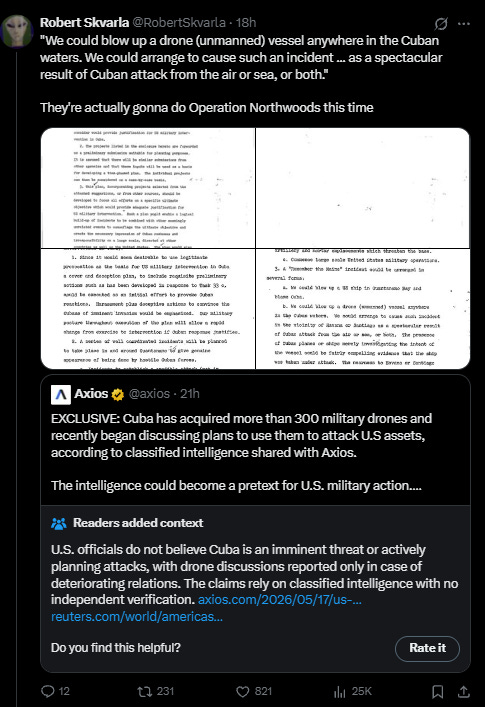
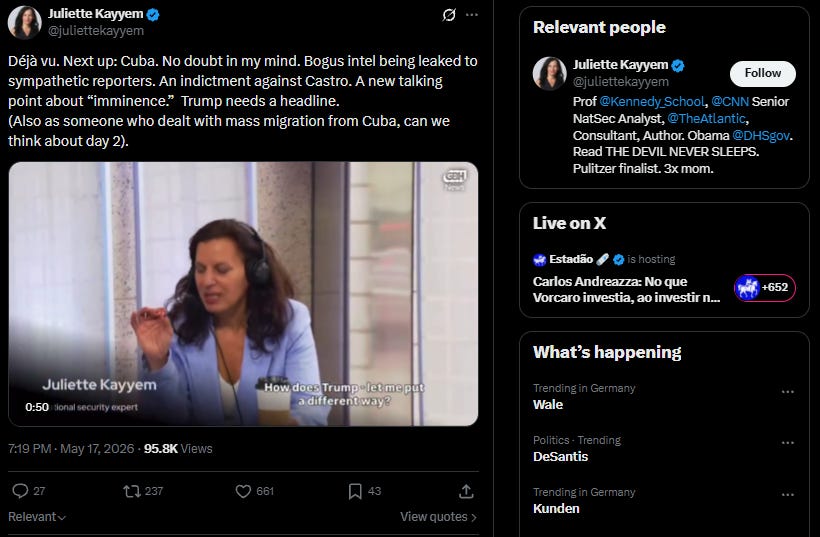
In my humble opinion, I get where people are coming from, but I think some are being too quick to dismiss these claims. For one thing, as Caputo himself has pointed out in defense of his reporting, the Cuban diplomatic corps is notably avoidant of denying any of the specifics of the piece itself, especially the drones. For another, aside from the Cuban government’s highest echelons, I don’t think anyone ‘knows’ whether these allegations are true one way or another. If someone has either secret Cuban military intel or a high level Trump admin source willing to state in no uncertain terms that this is made up, we’re all in the dark here to some degree. We can talk about likelihood, but not about certainty. So, if we’re talking purely about whether the claims here make sense, in my view they do.
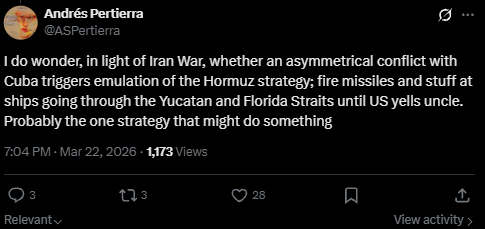
In fact, it’s something I wondered about almost two months ago in response to the ratcheting up of tensions in the direction of US military intervention in Cuba. At the time people rightly pushed back on this idea, because Cuba can’t emulate the Hormuz strategy as this is no small thing. It required significant economic and military preparation for it. Cuba is also much closer to the US, so the American military response would presumably be even easier than sending ships to the literal other side of the planet. I agree Cuba can’t just ‘do the Hormuz strategy’ in the sense of emulating it at the same level, but in my view it doesn’t have to in order for this to be a viable component of a broader strategy of resistance. Cuba has no huge fleet of drones, but it can make vessels going through the straits of Florida or Yucatan feel like they’re rolling the dice by passing through, at least American vessels, and the mere threat that something happens is enough to increase costs and deter vessels from trying without guarantees, maybe an escort, etc. Thus, Cuba doesn’t have to be Iran in order to see this as a tool in their toolkit if they are attacked. Cuba cannot beat the US militarily, but like with its long-standing strategy of guerrilla warfare if invaded, all they have to do is impose pain on their adversary until the economic and political costs force a change in tact from the aggressor. If I were the Cuban government, I would probably be doing exactly this, while also keeping it secret for fear of being seen as escalating the situation.
So, we’ve handled the factual question (it’s still an open question), and the likelihood question (it makes logical sense), but there’s a third component at play; regardless of truth, it serves the purpose of drumming up a war. This is undoubtedly true. Whether with Trump’s authorization or on their own initiative and regardless of intent, the idea that Cuba is potentially a military threat to US shipping or military vessels in and out of the Gulf of Mexico is an escalatory piece of news. One that a hawkish Marco Rubio could cynically use as the casus belli he has been looking for; an excuse for preemptive intervention. I don’t contest this argument, already being put forward, in the sleightest.
So the last question becomes ‘okay, how do we respond?’ I think the first step is to not overstep what we actually know here. We do not know the truth of the claims, ergo we should neither state them as fact nor deny them out of hand. We can explain likelihood if that’s something people are interested in, and I’m sure my analysis doesn’t map onto what others think is likely, so this is a space for earnest debate. What we can be clear on, however, is that regardless of drones, Cuba isn’t a military threat to the US. That the US oil blockade is causing widespread economic pain suffered first and foremost by Cuba’s poor, who cannot afford solar panels nor battery power for nights nor the hard currency with which they might buy gas (when there is gas,) or the high prices for food and imported medicine. That if the US administration tries to use this unsubstantiated story as an excuse for war with Cuba, we should oppose it as something they have neither proven nor do they have the credibility to say we would never make something like this up; don’t even go back to WMD claims during the Bush administration, just look at Trump’s long history as a pathological liar over the past decade. I wouldn’t trust him to say the sun is shining, much less that a country he wants to invade potentially has something which he thinks justifies a military intervention.
Above all, I think discussions should focus on truth and transparency. Not out of some kind of blind idealism, but because being the honest brokers in a conversation is one of our greatest strengths. Dismissing things out of hand when we can’t know one way or the other is precisely like shooting ourselves in the foot. It’s hard to stop a moving train once it gets going, but it’s even harder to catch up with one while hobbling around with a gunshot wound.