A Wolf by the Ears
What to do when no one promises to forget

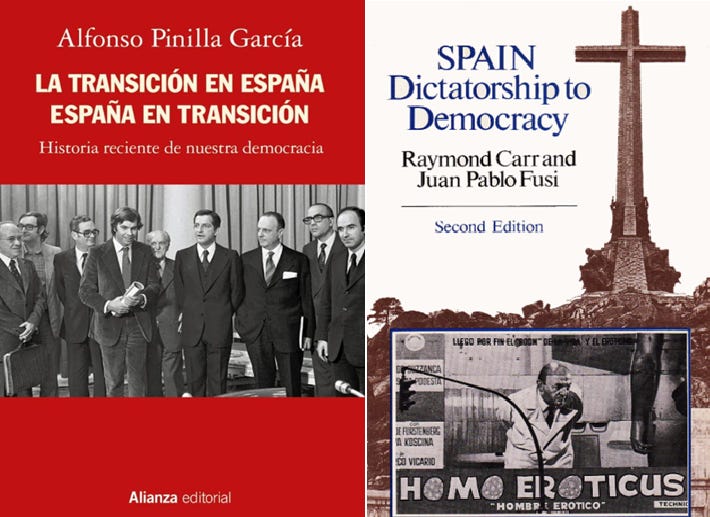
A key pillar of the Spanish democratic transition in the 1970s was the so-called ‘Pacto del Olvido’; literally the ‘Pact of Forgetting’. There was a lot of violence in the Spanish 20th century, especially during the Civil War (1936-1939), a pattern to which the final decades of Francisco Franco’s personal dictatorship (1939-1975) were no exception. When the old Caudillo mercifully died in November of that year, he left his regime in a precarious position.
The Franquista regime was falling apart. The youth had already been lost to ‘the Movement’ (as the official party was known) and the oil shocks of the early 1970s were creating sufficient economic instability that strikes were growing geometrically; this usually not a great development even in an autocracy. The regime continued to have a solid sector of supporters but aside from a group of ultras, nicknamed ‘the bunker’ in a reference to Hitler and his closest associates, there was growing awareness among most of society that the status quo was untenable.
For one thing, Spain’s regime being undemocratic meant it couldn’t join the EEC (now the EU) and all the benefits this brought. For another, the shrinking share of the population who supported the regime made it increasingly untenable to hold onto power, especially without ratcheting up the use of force. Separatism was also on the rise, with the Basque terrorist group ETA having turned Franco’s would-be successor, Luis Carrero Blanco, into ‘Spain’s first astronaut‘; they packed so much explosive material under his car’s commute route that when it blew up his vehicle flew over a building and into the yard behind it. While the regime was brought to power by hardliners and more traditionalist conservatives, the Spanish ‘economic miracle’ of the 1960s and 1970s was more a product of conservative but technocratic and pragmatic businessmen who did not necessarily need the regime to be authoritarian, just stable and capitalist. Here I’m thinking of figures in government like reformist government minister Manuel Fraga Iribarne, but also businessmen like car mogul Eduardo Barreiros; both hunting buddies of the Caudillo.
The benefits of liberalization in politics were clear to many, and even those who weren’t true believers in it could accept it pragmatically, but there was one major problem; what to do about the day after? Say you ended the dictatorship tomorrow, ok, how do you make sure you’re safe if you were a supporter, a minister, a mid-level bureaucrat, a former thug who had cracked Republican skulls, etc.? They continued to have control of the country through police and military repression, but what happened the moment they put down their guns?
The opposition was also not exactly in a strong position either. While the regime was weak, they had the weapons, the trained troops and cops, and the lack of any sort of organized opposition within the country which would permit it to succeed if it tried some kind of uprising. The leadership of most opposition organizations was abroad, even that of the Spanish Communist Party, which continued to function illegally within Spain in spite of constant repression. In the long-term, it was clear the regime was doomed, but how long would its fall take? And, if the opposition forced the issue, how many would die in the process?
For both sides, the memory of the 1930s still weighed heavily on them; did thousands and thousands of Spaniards have to die all over again in order for the country to move forward? But, without forcing the issue, they were at an impasse. Franco’s regime was brutal and people would want revenge; so his supporters had reason to fear a transition. The opposition lacked the strength to force the issue yet and if they tried many would likely die while the regime itself might survive in some form. It was seemingly a stalemate.
The solution both sides found was to agree to ‘forget’. Amnesties for the crimes of the past, both Franquista and anti-Franquista alike, were a key part of the late regime’s approach to the uncertainty of what would come next. But what made this a workable solution was that the opposition was also willing to play ball. Even Santiago Carrillo, a key leader of the Spanish Communist Party, refused to blow up the transition in order to demand justice for the crimes of the past. As neither side had a decisive advantage and neither wanted the bloodbath required from a test of strength, an understanding seemed the most practical solution. Too many had died already, it was time to turn the page and build a new Spain. One built on mass graves full of dead who would never get justice, sure, but also one that provided a path to democracy and shared prosperity for that generation’s kids and grandkids. One that spared them the mass violence that would have to come from a test of strength with the regime. Enough fratricidal political violence had happened already, and recrossing that river of blood once more wouldn’t bring back the dead or guarantee a better future for those still living.
From this shared understanding, the Franquista coalition was willing to accept a democratic transition. It was directed from above, was a close thing at times (especially the failed coup attempt of 1981), it took the conniving support of Juan Carlos I, and the replacement of the insufficiently pliable Carlos Arias Navarro, sure, but it happened.
These kinds of solutions are not specific to the Franquista regime either. A negotiated transition where the perpetrators of the previous regime received varying degrees of immunity is also seen in other famous cases, like Chile after the exit Augusto Pinochet. It is also my understanding that this applies to the Brazilian Junta but I am far less informed on that example. Was it justice? No. Did it guarantee that there wouldn’t be hard right figures in the future who tried to restore the old regime? Certainly not, just look at Bolsonaro’s attempted coup a few years ago. But it was a solution that was available and which, for all its flaws, actually worked in a situation where neither side was willing to surrender.
I am sure that by now my readers have already guessed at the parallels I am thinking of in terms of Cuba. A Pacto del Olvido for Cuba seems hard to imagine at the moment. You do have a regime with its back against the wall and no clear way to continue holding onto power without increased repression, sure, but you also have the context of Florida exiles (led and personified in this by Marco Rubio) who would be unlikely to accept a transition without being able to take their fury out on at least the leadership and likely also other collaborators, including those who served as undercover sources for Cuba’s police state apparatus. If at all, an amnesty for those who break with the regime seems far more likely to me than a total amnesty that allows the country to move forward. As with Spain, neither side is strong enough to overturn the other and a test of strength will bring more suffering and death, but the regime in this case (rightly) fears that surrender would be total and the vengeance swift and brutal not just for themselves but everyone they care about around them. Surrendering to US pressure and Florida influence would be simultaneously a betrayal of their entire ethos and identity but a betrayal of their own interests and those of the people they care about most.
This means that US pressure, like a Chinese finger trap, is pulling the frayed fibers of the regime coalition together, giving it cohesion rather than pulling it apart. In this sense Trump’s maximum pressure strategy is continuing the role the US pressure has historically played in domestic Cuban politics. Like any finger trap, with enough pressure the fibers will begin to snap until the whole structure snaps in half; continued US pressure seems to set the country on a course for violent and chaotic regime collapse rather than regime change.
In advising his readers back in the early 16th century, Machiavelli argued time and again that for foes the solutions were either magnanimity or to be so brutally devastating that they could never hurt you ever again. In his book Discourses on the First Decade of Titus Livy, Book 2, Chapter 23, he cites the mistake of the Samnites with Rome, to humiliate rather than pardon or destroy a force they had trapped, which resulted in the Romans coming back on the Samnites to wreak vengeance. He argued the Romans had to have either been destroyed there, whatever the cost, or pardoned such that they were demoralized. With Cuba, forgiveness seems to be off the table; I worry about what the alternative looks like.